
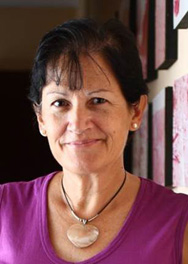
Dr.Nicole Bernex
Academic Director of the Research Center in Applicated Geography (CIGA, acronym in Spanish) of the Pontificical Catholic Univeristy of Peru. Member of the Technical Committee of GWP. Emeritus Vice Chair of GWP South America and Emeritus Chair of GWP Peru. Author of numerous scientific articles and books, among which are: the biography of Raimondi and the Regional Atlas of Piura and Quispicanchi.
Member of the National Academy of Sciences. Responsible of several research projects.
Please tell us, how is it that you chose Peru?
I was born in Carthage, Tunis. I am married with 3 children and I am a grandmother. Love brought me to Peru and my love to this wonderful country has kept me here for almost 40 years.
Firstly, I was very surprised when I realized that we have more than 70 000 m³/person/year. Then, I recognized the huge gaps between Pacific and Amazonian water basins; between poor and rich people; between different uses, and between men and women.
What is it like your professional career as a woman?
During my 40 years as a geographer, I have focused my research mainly on rural and urban land planning, water basin management, sustainable development and more recently on climate change adaptation processes in Peru and other South American countries. I am doing a lot of fieldwork in the Amazonian basin, but also in the Andes and coastal areas.
Usually, there are very few women and it is crucial to empower them to participate in governance organizations and decision-making processes.
In your view, how are women and water linked?
For women there is a very close nexus between water and health, water and food, water and livestock. I learn a lot from each of them and today I am certain that the issues of resource degradation and aquatic ecosystems regeneration are closely linked to matters of power, governance, institutions, livelihood, education and culture, and women have to play a great role in Integrated Water Resources Management.
How do you view the role of empowerment of women in water issues?
To strengthen the role of women in water management means two things:
Firstly, recognize that “women play a central part in the provision, management and safeguarding of water”.
Secondly, it is necessary to strengthen water education and capacity building to enable women to improve their futures and the future of their families.
It is sound to improve the role of the women in water politics, facilitate their access to information, capacity building and to create careers for women.
Eng. María Angélica Alegría Calvo
Hydraulic Civil Engineering, expert on Water Resources and Environmental Management. Worked for years at the General Water Directorate (DGA, Spanish acronym) ormer GWP South America and GWP Chile Chair.
What would you say are the main challenges in your work as a woman?
The challenges depend on what kind of work you do have in the water world. When you are a project engineer, you have fewer responsibilities but more work and there is room for inequities and injustices. Hierarchical professionals may demand work in excess, more than what they demand to male professionals of similar level.
As long as you advance in seniority, you get more responsibilities and you can reach higher positions but always with less salaries for equal tasks added to the fact that we still live in a society where the mother's role demands a lot of time invested in parenting and education, more than men.
What have you done to overcome these obstacles/challenges?
To sort these obstacles one important thing is to have strong beliefs and mindset as to your our value as a person and as a professional, besides a strong character to say no to injustices and inequities. It is interesting as you can realize how different are men from women in the way they accomplish their duties. If you are able to spot those differences and you get to know each member of your team, you will be able to get the best out of him/her, what turns into a virtuous circle and in this way any bias or discrimination is eliminated. Women and men are different and complementary and together can get much better results regarding water challenges.
Recommendations to other women in similar situations (in the water world)?
Make the difference! Be horizontal as a boss and very proactive and empathic as a professional. Be the best in your area of expertise. Always think ahead, anticipating facts and times. Care about your staff and your team, be understanding but rigorous. Educate them as solid professionals with your example. You always get better responses and better disposition from people who respect and appreciate their boss.